
What replaced the type A permit
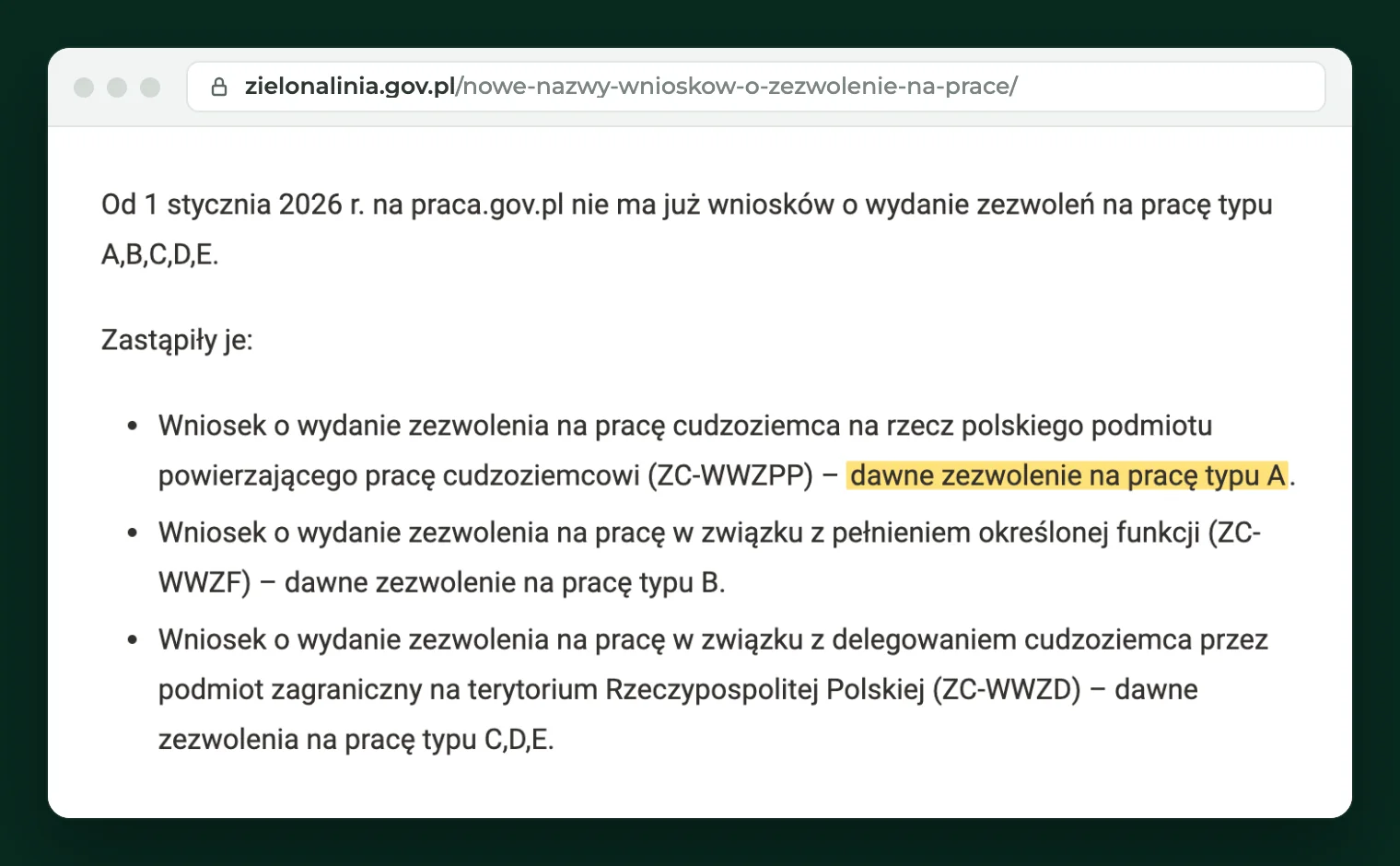
Since 1 June 2025 the work of foreigners has been governed by the Act of 20 March 2025 on entrusting work to foreigners, Dz.U. 2025 poz. 621. It has no letters A, B or C. The former type A permit is now called a work permit for a foreigner working for a Polish employer. It is issued by the voivode responsible for the employer's registered office, Art. 26 sec. 1 of the Act.
Since 1 January 2026 praca.gov.pl no longer has type A forms either. That application is now called ZC-WWZPP.
Who needs a permit
A permit is needed by a non-EU foreigner who will work under a contract with a Polish employer and has no free access to the labour market, Art. 6 sec. 1 point 1 of the Act. A seasonal permit covers farming and tourism, not warehouses or factories, Council of Ministers regulation of 25 November 2025, Dz.U. 2025 poz. 1654.
Free access to the labour market applies, among others, to people with permanent residence, EU long-term residents, people under temporary protection, Pole's Card holders and graduates of Polish universities, Art. 3 of the Act. Zielona Linia publishes the full list. A holder of a temporary residence and work permit does not need a separate work permit either, we cover that permit in Residence card in 2026.
Since 1 December 2025 the simpler route, a declaration on entrusting work, is open only to citizens of Armenia, Belarus, Moldova and Ukraine, Ministry of Family, Labour and Social Policy regulation of 21 November 2025, Dz.U. 2025 poz. 1617. Workers from Nepal and India still need a permit. Ukrainian citizens staying in Poland legally can work on the basis of a notification until early March 2029, Art. 41 of the Act of 23 January 2026, Dz.U. 2026 poz. 203. More in UKR status in 2026.
The employer applies
The permit is issued at the employer's request, Art. 8 sec. 1, and only the employer is a party to the case, Art. 12 point 1. The worker does not apply and cannot appeal a refusal personally. Since 1 June 2025 the application can only be filed online, through praca.gov.pl. An application filed any other way is left unexamined, Art. 8 sec. 2 and 3.
From the worker, the employer needs a scan of every completed page of a valid passport, § 2 of the ministry regulation of 20 November 2025, Dz.U. 2025 poz. 1629.
The permit alone does not give the right to stay. The foreigner arranges a visa or residence card personally, says the Polish public employment services portal.
What it costs and who pays
Since 1 December 2025 the application fee is PLN 400 if the work is to last more than 3 months and PLN 200 for shorter work, § 2 of the ministry regulation of 20 November 2025, Dz.U. 2025 poz. 1622. The employer pays it, separately for each application, Art. 10 sec. 1 of the Act.
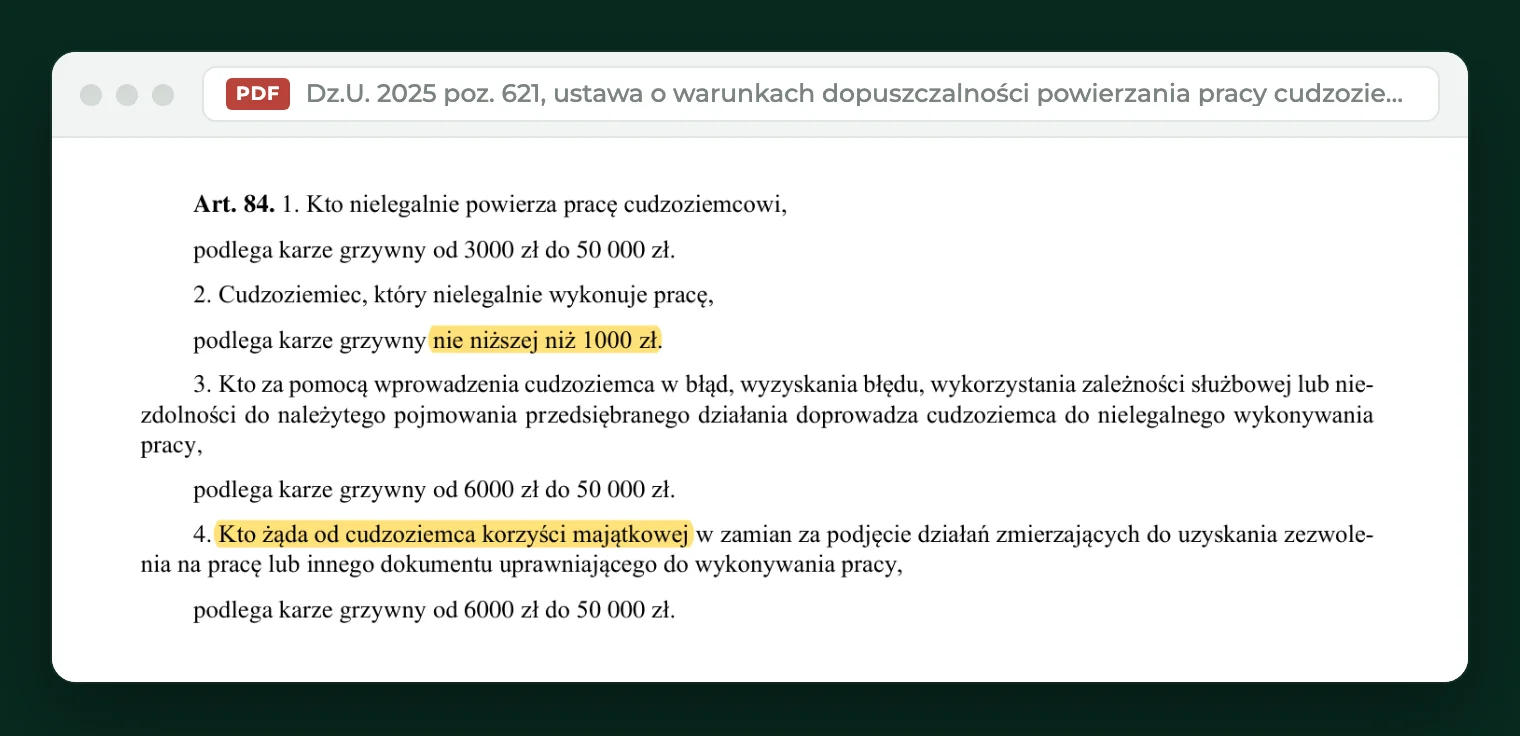
The worker does not pay for the permit. Anyone who asks a foreigner for money in return for arranging a work permit faces a fine of PLN 6,000 to 50,000, Art. 84 sec. 4, and at least PLN 6,000 for each foreigner, Art. 84 sec. 14. Under the old Employment Promotion Act the range was PLN 3,000 to 30,000.
Since 1 June 2025 the employer no longer needs the starost's information, the so-called labour market test. Instead, the starost may draw up a list of occupations in which the voivode will refuse a permit, Art. 31 of the Act. According to the public employment services portal, no such list exists yet.
How long the decision takes
The Act sets no separate deadline, so Art. 35 § 3 of the Code of Administrative Procedure applies. The case should be settled within a month, or within 2 months if it is particularly complex. A complaint about delay under Art. 37 of the Code cannot be filed in these cases, Art. 7 sec. 4 of the Act.
The offices themselves warn that cases take longer. The Mazowieckie Voivodeship Office mentions a large number of cases and technical problems with the system.
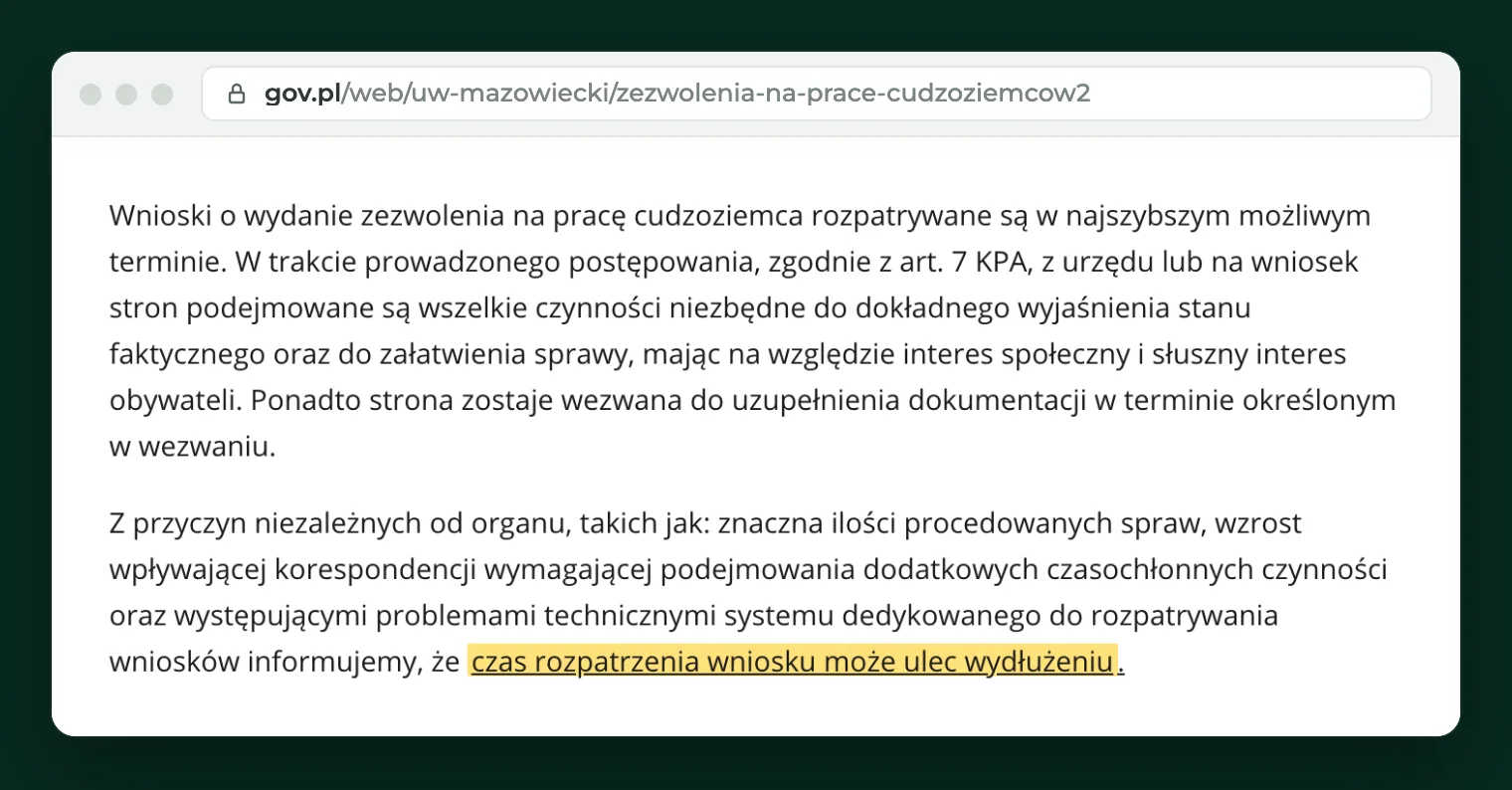
The office websites we checked publish no figures on actual waiting times. The decision reaches the employer through praca.gov.pl. The employer can appeal a refusal to the labour minister, through the voivode, within 14 days of delivery.
Contract and pay
Pay may not be lower than for workers in a comparable position or lower than the minimum wage. Working time is between a quarter of full time and full time, Art. 30 sec. 1 and 2 of the Act. The minimum wage in 2026 is PLN 4,806 gross a month. From 1 January 2027 it will be PLN 4,950, Council of Ministers regulation, Dz.U. 2026 poz. 1213. When the minimum wage goes up, the employer must raise the foreigner's pay, Art. 17 sec. 1 point 3.
The contract is signed in writing before the foreigner starts work, Art. 5 sec. 1. Entrusting work without a written contract is illegal, Art. 2 point 2 letter f. If the contract is in Polish and the foreigner does not speak Polish, they receive its content in writing in a language they understand before signing, Art. 5 sec. 2. The National Labour Inspectorate explains that this does not have to be a sworn translation, and the employer hands one copy of the contract to the worker.
The employer keeps the foreigner informed about the permit case and passes on the decision, or information about a refusal, Art. 17 sec. 1 points 6 and 7.
The permit states the employer's details, the position, working time, minimum pay, type of contract and validity period, Art. 32 sec. 1. The Act opens the permit register to authorities, consuls, the labour inspectorate and the Border Guard, not to workers, Art. 76 sec. 1. That is why it pays to compare the decision with the contract before signing.
D visa from Nepal and India
Working on a permit requires a national visa issued for work, Art. 3 sec. 3 point 1 of the Act and Art. 60 sec. 1 of the Act on Foreigners. Since 1 June 2025 you cannot work on a tourist visa, a visit visa or a visa issued by another Schengen country.
Nepali citizens apply at the embassy in New Delhi. Residents of India apply in New Delhi or at the consulate in Mumbai, depending on the state. Each office only accepts applications from people who live legally in its consular district. Registration goes through e-Konsulat, and the date of the VFS appointment is drawn by lottery.
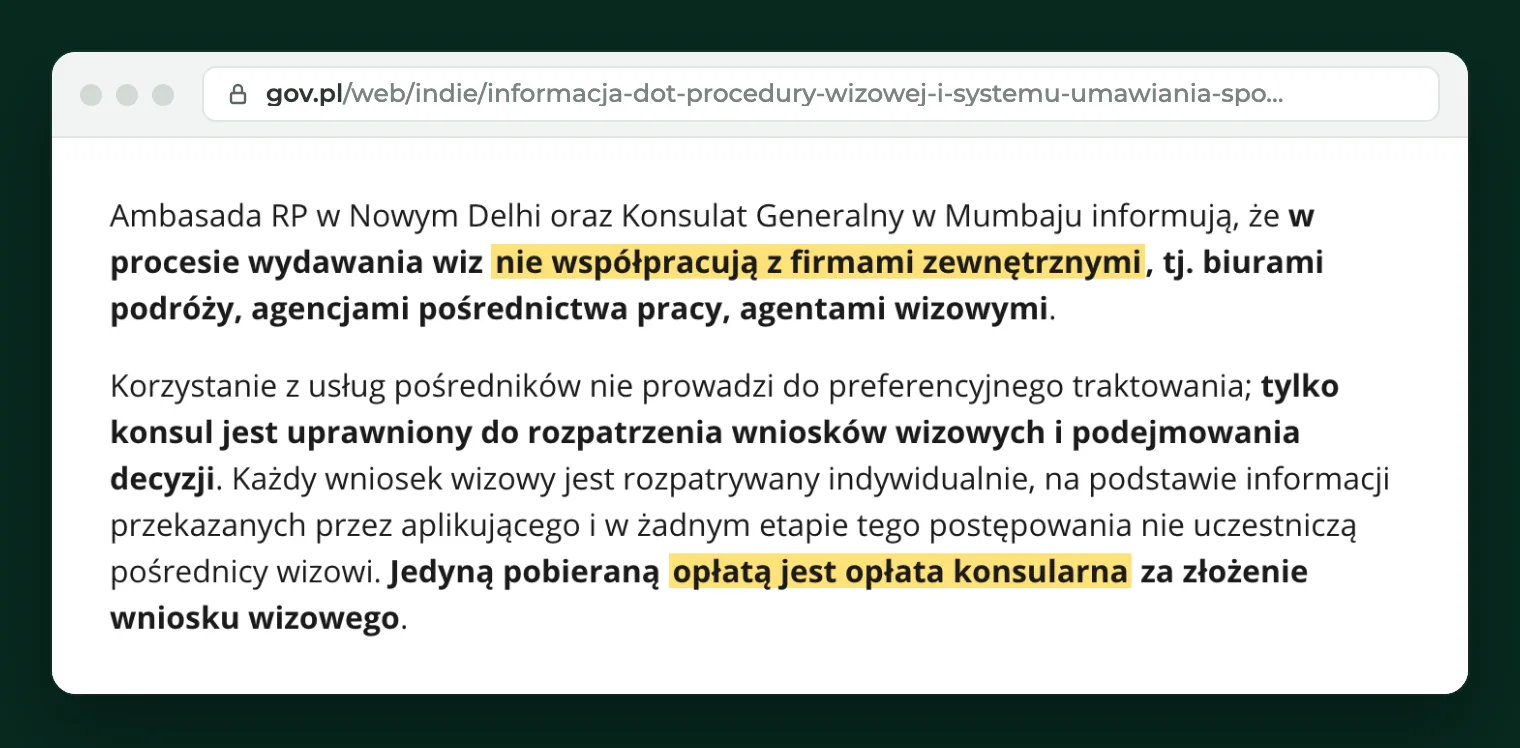
The embassy and consulate state that they do not work with intermediaries and that the only payment is the consular fee. It is not refunded after a refusal.
The application needs, among other things, the original and a copy of the work permit, the employer's KRS extract, a letter from the employer with the position and pay, health insurance of at least EUR 30,000 and proof of accommodation in Poland. The full list is in the embassy checklist of 18 February 2026. Documents must be in Polish or English and cannot be sent later.
The consul decides within 15 days, or within 30 in justified cases. After a refusal you can ask for a review within 14 days, paying a new consular fee. A national visa is valid for one year at most, according to the embassy page on the D work visa.
Once the foreigner is working in Poland
A permit is issued for 3 years at most, Art. 15 of the Act. Permits are no longer extended, the employer applies for a further permit instead. If the employer files a complete application before the current permit expires, work on the existing terms stays legal until the final decision, Art. 21 sec. 1.
The foreigner may only work for the employer named in the permit, and another employer must obtain its own permit, as the employment services portal reminds. Entrusting work on other terms or in a different position than in the permit is illegal, Art. 2 point 2 letter d.
No new permit is needed when the employer changes its registered office, name or legal form, when only the job title changes, or when working hours go up with proportionally higher pay. Since 8 July 2026 the same applies when a civil law contract is replaced by an employment contract, Art. 18 sec. 1 and Art. 33 sec. 2 as amended by the Act of 11 March 2026, Dz.U. 2026 poz. 473.
Within 7 days the employer notifies the voivode if the foreigner did not start work within 2 months, stopped work for more than 2 months or finished earlier than 2 months before the permit ends, Art. 19 and 20. Since 1 June 2026 this is done through praca.gov.pl. The voivode then revokes the permit, Art. 22.
Refusal and fines that affect the worker
The new Act added a ground for refusal that concerns the worker. If within 2 years before the application the foreigner held a permit or declaration, came to Poland to work and did not work without a valid reason, the voivode will refuse the permit, Art. 13 sec. 1 point 10. The old Act had no such ground.
A foreigner working illegally pays a fine of at least PLN 1,000, Art. 84 sec. 2. The old Act set no minimum. Illegal work also means working without a required permit or on a stay that does not allow work, Art. 2 point 3.
If something seems wrong, you can ask the National Labour Inspectorate for free. The inspectorate checks whether foreigners work legally and gives advice by phone, including in Ukrainian. Since 8 July 2026 it can also decide on its own that a civil law contract is in fact an employment relationship.